Noise-induced hearing loss is one of the most common—and most preventable—workplace injuries. Whether you’re working in construction, manufacturing, landscaping, or aviation, understanding how noise exposure limits work is critical to protecting your hearing long-term.
Two organizations are most often referenced when it comes to noise standards in the workplace: Occupational Safety and Health Administration (OSHA) and National Institute for Occupational Safety and Health (NIOSH). While their recommendations are related, they serve different purposes—and that difference matters when choosing hearing protection and volume limits.
Let’s break it down.
OSHA’s Permissible Exposure Limits (PEL)
OSHA establishes legally enforceable noise limits for U.S. workplaces under regulation 29 CFR 1910.95. These limits define how much noise exposure is allowed over time.
OSHA’s Key Noise Thresholds
-
90 dBA – Permissible Exposure Limit (PEL)
Workers may be exposed to an average of 90 dBA over an 8-hour workday. -
85 dBA – Action Level
At this level, employers must implement a Hearing Conservation Program, which includes: -
Noise monitoring
-
Hearing tests
-
Training
-
Access to hearing protection
-
5 dB Exchange Rate
For every 5 dB increase, allowable exposure time is cut in half.
Example:
-
90 dBA → 8 hours
-
95 dBA → 4 hours
-
100 dBA → 2 hours
OSHA’s standards are designed to balance worker protection with industrial feasibility. They represent the minimum legal requirement, not necessarily the most conservative health guidance.
NIOSH Recommended Exposure Limits (REL)
NIOSH, unlike OSHA, is a research agency, not a regulator. Its limits are recommendations, based purely on hearing loss prevention—not enforcement practicality.
NIOSH Noise Standards
-
85 dBA for 8 hours (Recommended Exposure Limit)
-
3 dB exchange rate, meaning:
-
Every 3 dB increase doubles sound energy
-
Exposure time is reduced more aggressively
Example:
-
85 dBA → 8 hours
-
88 dBA → 4 hours
-
91 dBA → 2 hours
NIOSH’s limits aim to protect nearly all workers over a 40-year career, including those more susceptible to hearing damage.
OSHA vs. NIOSH: What’s the Difference?
|
Organization |
Limit Type |
8-Hour Limit |
Exchange Rate |
|
OSHA |
Legal requirement |
90 dBA |
5 dB |
|
NIOSH |
Health recommendation |
85 dBA |
3 dB |
In short:
-
OSHA sets enforceable minimums
-
NIOSH sets best-practice guidance
Both are important—and both are used when designing hearing protection strategies.
Why the OSHA 85 dBA “Action Level” Is Often Misunderstood
One common misconception is that 85 dBA is a hard safety limit. It’s not.
The OSHA Action Level simply means that:
-
Employers must begin monitoring and prevention efforts
-
Hearing conservation becomes mandatory
-
Exposure is not automatically unsafe
Actual regulatory noncompliance doesn’t occur until the 90 dBA PEL is exceeded as an 8-hour average.
This distinction is critical when talking about headphones and communication devices.
Why ISOtunes SafeMax™ 90 dB Headphones Are Still Hearing-Safe
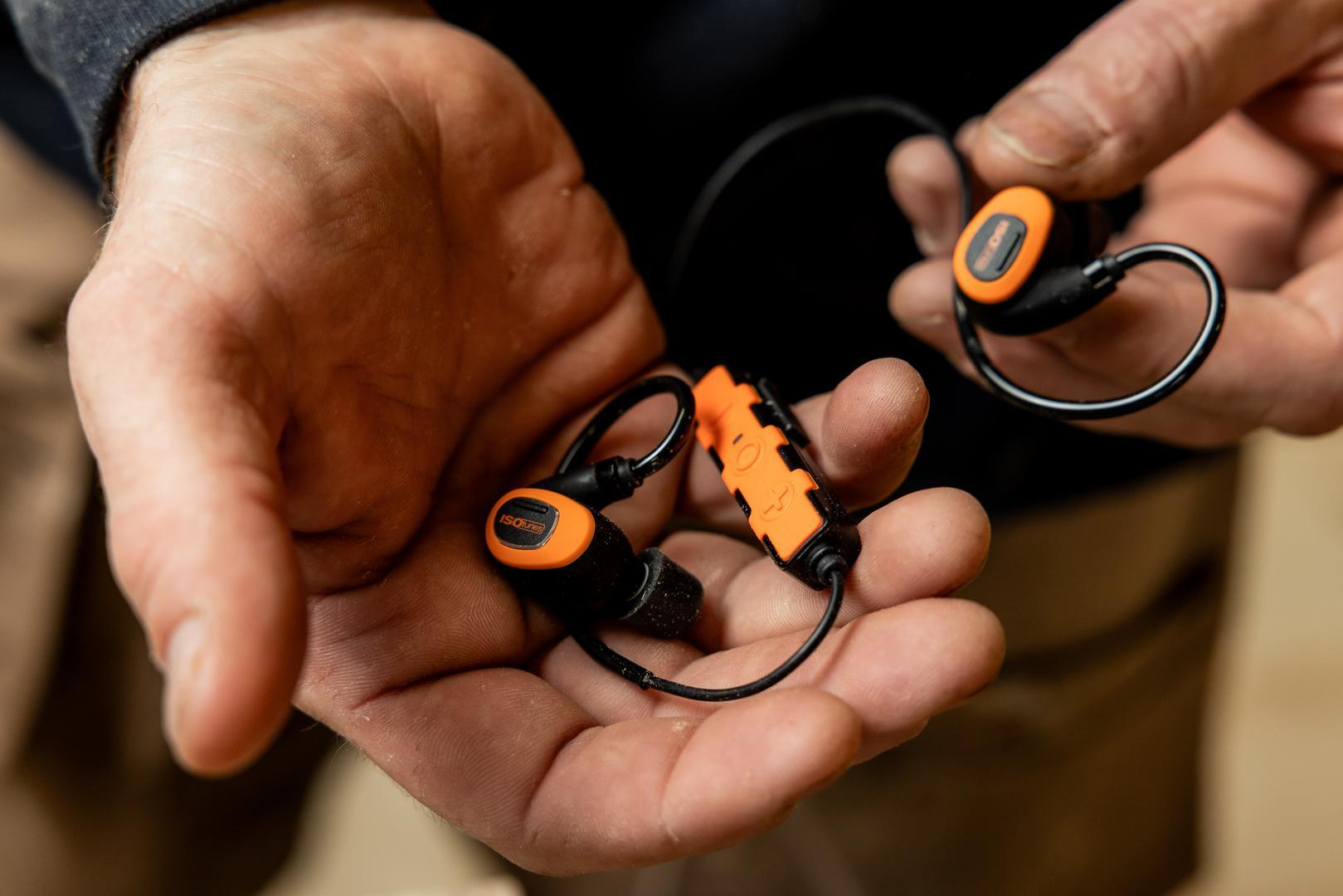
All ISOtunes products feature SafeMax™ volume-limiting technology for hearing conservation. Most our products sold in North America feature SafeMax™ 85 dB limits for use in industrial environments in accordance with OSHA and CSA regulations. In Europe, on the other hand, all ISOtunes products feature SafeMax™ 82 dB volume limits to comply with local EN352 regulations. Some ISOtunes products in North America, however, now feature our new SafeMax™ 90 dB volume limit, including the products in our ISOtunes Sport line and some consumer models within the ISOtunes line (like the PRO 3.0 in Matte Black, for example, pictured below). At first glance, 90 dB may sound risky—especially since it’s higher than OSHA’s 85 dBA Action Level. But context matters.

1. Noise Limits Are Based on Time-Weighted Averages
OSHA and NIOSH limits apply to average exposure over time, not instantaneous peaks.
A device capped at 90 dB SPL does not mean the user is exposed to 90 dB for 8 straight hours.
In real-world use:
-
Volume fluctuates
-
Speech and audio are intermittent
-
Average exposure is often well below the maximum volume and/or maximum allowable time
2. Headphones Are Used Instead of Louder Environmental Noise
In industrial settings or at the range, environment noise from equipment, machines, and firearms can exceed 95–105 dBA.
Properly designed hearing protection devices with integrated audio, like ISOtunes:
-
Reduce ambient noise
-
Allows communication at lower effective listening levels
-
And prevent users from dangerously over-amplifying audio to “hear over” machinery
As a result, our ISOtunes headsets capped at 90 dB typically enable lower total daily noise exposure than unprotected ears in loud environments.
3. 90 dB Is Below OSHA’s Legal Exposure Limit
From a regulatory standpoint:
-
90 dBA is OSHA’s maximum allowable 8-hour exposure
-
A capped headset cannot exceed that ceiling
-
Short-duration or intermittent use stays well within safe margins
This makes a 90 dB cap compliant with OSHA standards and compatible with hearing conservation programs when used correctly.
However, due to OSHA’s 85 dB Action Level, we recommend sticking to ISOtunes SafeMax 85 dB or 82 dB max output models for use in regulated work places.
4. Hearing Conservation Is About Risk Management, Not Zero Sound
Hearing safety isn’t about eliminating sound—it’s about controlling dose over time.
A capped-volume device:
-
Prevents extreme overexposure
-
Encourages consistent hearing protection use
-
Supports situational awareness and communication (which also improves safety)
When combined with attenuation from hearing protection, a 90 dB maximum output aligns with both OSHA compliance and NIOSH-informed best practices.
The Bottom Line
-
OSHA allows up to 90 dBA averaged over 8 hours
-
NIOSH recommends 85 dBA for more conservative protection
-
The 85 dBA Action Level is not a danger line, but a prevention trigger
-
A 90 dB max headphone volume can be hearing-safe because:
-
It’s a maximum, not a constant level
-
It’s used alongside noise-reducing protection
-
It often lowers overall daily noise exposure
Just as important: even at a 90 dB maximum sound pressure level, ISOtunes headphones are significantly safer than most consumer headphones, many of which can reach 95–100 dB SPL or higher with no volume limiting at all.
Those higher output levels dramatically reduce safe listening time and increase the risk of accidental overexposure—especially in loud environments where users instinctively turn the volume up to overcome background noise. By contrast, ISOtunes’ built-in volume limiting helps prevent dangerous spikes, keeping audio levels within a range that aligns with workplace hearing conservation principles.
In real-world use, that means:
-
Lower risk of cumulative hearing damage
-
More predictable, controlled exposure
-
Better compliance with safety programs
-
Safer communication in high-noise jobsites
When hearing protection is designed specifically for work—not entertainment—volume limiting isn’t a compromise. It’s a safeguard that helps workers protect their hearing today while preserving it for decades to come.
At ISOtunes, hearing protection isn’t just about compliance—it’s about helping workers protect their hearing for life, without sacrificing communication, awareness, or productivity.